

Standard business card size: inches, mm and pixels

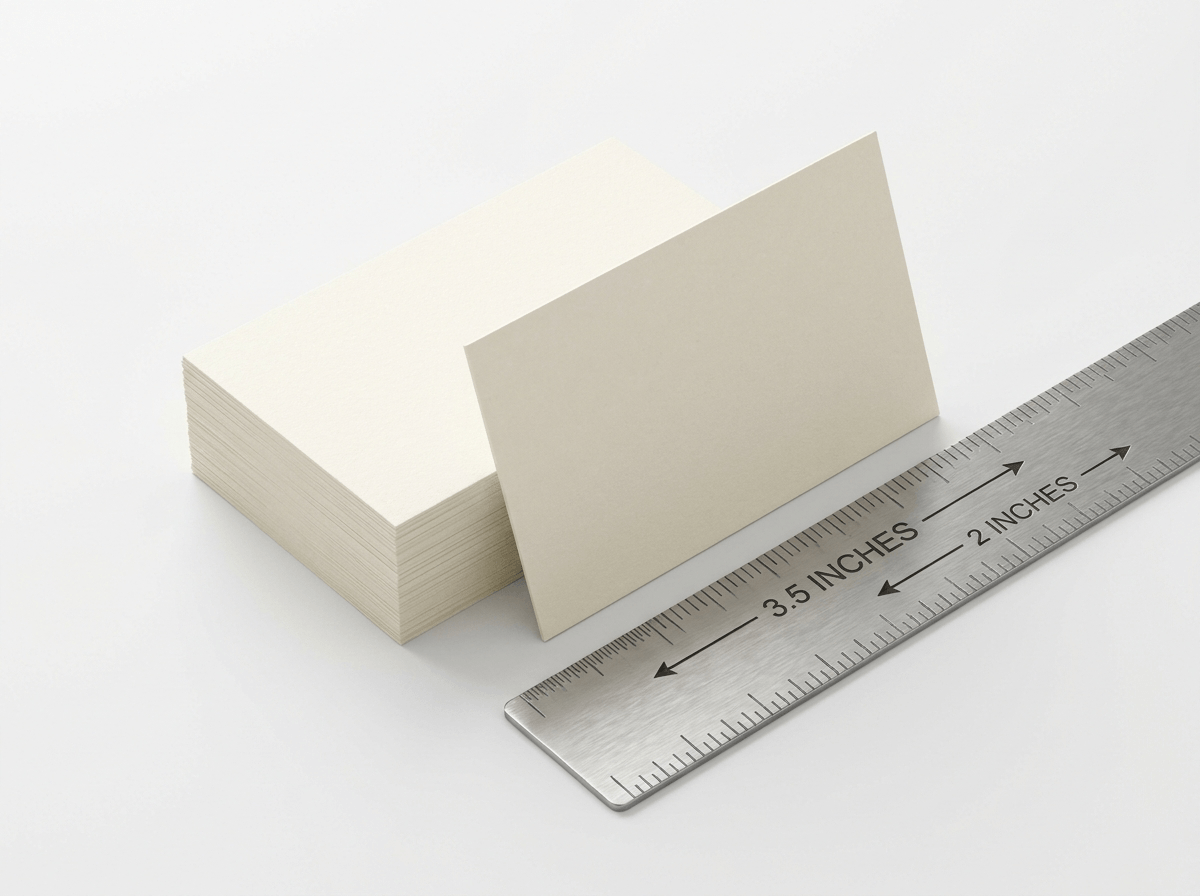
The standard business card in the United States and Canada is 3.5 × 2 inches, which is 89 × 51 mm. That size has held for over a century for a practical reason: it matches the credit cards, wallet slots and card holders everyone already owns. Design something bigger and it gets folded or binned; smaller and it slips loose and disappears.
The number for every format
- Inches: 3.5 × 2
- Millimeters: 89 × 51
- Pixels at 300 DPI: 1050 × 600
- With bleed: 3.625 × 2.125 in (1088 × 638 px)
- Safe zone: 3.25 × 1.75 in, keep all text inside it
Bleed is the eighth of an inch of extra artwork around the trim line. Printers cut stacks of cards in one stroke, and the blade drifts a hair. If your background stops exactly at the trim line, that drift leaves a white sliver on one edge. Run the background to the bleed line and keep logos and text inside the safe zone, and every card in the stack comes out clean.
International sizes are different
Hand your card to a European client and theirs will be slightly wider and shorter: 85 × 55 mm is the standard across most of Europe and the UK. Japan uses 91 × 55 mm, and the exchange of meishi there is formal enough that getting the size right matters. If your business works across regions, print separate runs rather than splitting the difference; a nonstandard card fits nobody's holder.
Thickness is the second spec
Card size gets the attention, but stock weight is what people feel. 14pt is the standard trade weight, fine for volume handouts. 16pt has noticeably more snap. Past that you get into 32pt and triplex builds that feel like a coaster and price like one too. Match the weight to the job: a contractor's leave-behind can be 14pt, a design studio's card probably shouldn't be.
When to break the standard
Square cards (2.5 × 2.5) and slim cards (3.5 × 1.5) stand out precisely because they ignore the wallet rule, which is a real trade: memorable in the hand, easy to lose afterwards. Folded cards give you 3.5 × 4 of space that closes to the standard footprint, useful when a menu or price list has to ride along.
Quick answer
3.5 × 2 inches, 89 × 51 mm, 1050 × 600 px at 300 DPI. Add 0.0625 in of bleed per side and keep text an eighth of an inch off the trim. The same trim-and-bleed logic applies to every small-format print job, from rack cards to hang tags.
Ready to print your packaging?
Get an instant quote in minutes — low minimums, fast turnaround, and finishes that make your brand pop.